

Swarm Intelligence
Swarm intelligence is the collective behavior of decentralized systems in which complex tasks are accomplished by individual agents adhering to basic rules. It frequently draws inspiration from the way social animals like ants, bees, and birds naturally cooperate to accomplish a common objective. In order to produce coordinated behavior, these systems rely on local interactions and feedback rather than centralized control.
Imagine a flock of birds flying in perfect formation, or a colony of ants finding the shortest path to food — all without a leader. This natural coordination has inspired a fascinating field in computer science and artificial intelligence known as Swarm Intelligence.
In simpler terms:
Swarm intelligence is when a group of simple units (like ants, bees, or robots) work together to solve problems in a way that looks smart — even though no single unit is very smart on its own.
In this blog, we’ll explore what swarm intelligence is, how it works, its real-world applications, and why it’s becoming a cornerstone of future technology.
Biological Inspiration Behind Swarm Intelligence
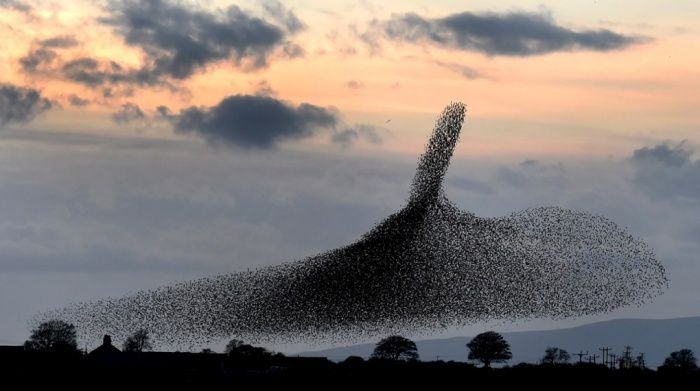
Swarm intelligence’s foundations are largely inspired by nature. Ant colonies, for example, exhibit exceptional efficiency in both nest construction and foraging. Swarms of bees are also very good at locating their hives in the best possible places. Simple rules governing individual movements can result in coordinated group dynamics, as demonstrated by fish schooling and bird flocking. These biological systems inspire scientists to develop algorithms that show these behaviors, providing answers in a range of practical domains.
Swarm intelligence is deeply inspired by biological systems, especially the collective behavior of social animals. Some key examples include:
Ant Colonies: Ants leave pheromone trails to help others find food, enabling the colony to discover the shortest paths without central planning.
Bee Swarms: Honeybees collectively decide on new hive locations through a democratic process that balances individual discovery and group consensus.
Bird Flocking: Birds align their movement with their neighbors, avoiding collisions and maintaining formations in flight.
Fish Schooling: Fish move in synchronized patterns, offering protection from predators and enhancing foraging.
These systems all share something remarkable: local interactions create global intelligence.
Major Models of Swarm Behavior
Boids model (Craig Reynolds, 1986/87)
Description: One of the very first and most well-known. Agents (“boids”) navigate in an environment by means of three simple rules.
Fundamental rules:
Separation: evade dense neighbors (avoid collisions)
Alignment: move towards the average direction (heading) and speed of neighbors
Cohesion: They move towards the average location of nearby neighbors; therefore, they tend to remain together.
Extensions / Additional rules: obstacle avoidance, goal searching, boundaries, and different neighborhood definitions.
Applications: graphics/animation (animating flocks, schools of fish, crowds), robotics (multi-agent cooperation), virtual reality.
Vicsek model (Self-propelled particles)
Description: Simplified statistical physics model of collective motion. Proposed by Tamás Vicsek et al. in 1995. Agents travel at fixed speed, change direction according to neighborhood average (with some noise).
Key features:
Fixed speed for all agents.
Alignment of direction with neighbors in a radius or some neighborhood structure.
Some noise/randomness to enable disorder → order transitions.
Strengths: Extremely simple, ideal for studying phase transitions (disorder to order as noise reduces or density increases).
Weaknesses: Doesn’t have cohesion or explicit separation in some implementations; less realistic geometry; simple agent model.
Zone-based flocking models
Description: Variants of Boids and similar models utilize “zones” around each agent: e.g. a repulsion zone, an alignment zone, an attraction zone. Agent’s behavior based on which other agents are in which zones.
Recent variant: “Bearing-Distance Based Flocking with Zone-Based Interactions” — employs zones for repulsion, alignment, attraction, etc.; only local measurements (bearing & distance) required. Works in constrained / dynamic environments.
Strengths: It offers more flexibility, models realistic perception limits, and includes obstacles and boundary conditions.
Self-Propelled Particle systems (General class including Vicsek etc.)
Description: Agents are particles which “move themselves” (i.e. each has its own motion), interact locally with others, can have noise, and obey simple rules. It is a more physics/stat mech way of doing things.
Emergent behaviors: alignment, schooling, clustering, phase separation (e.g. motility-induced phase separation, clustering vs. dispersal)
Hydrodynamic / continuum models
Description: Rather than individually modeling each agent (Lagrangian, agent-based), such models perceive the swarm as a field or continuous medium. One works with densities, fluxes, and averaged fields. It suits large swarms by approximating individual behavior statistically.
Examples: deriving density and velocity field equations; kinetic theory of self-propelled particles; metric-free interactions. Reinforcement Learning / Learning-based modulation of swarm behavior
Description: Agents use learning (like RL) to adjust rules or policies based on the environment or opponents, replacing fixed rules with emergent behavior through training.
Example: SELFish (Swarm Emergent Learning Fish) — agents learned to evade predator, and the flocking is an emergent behavior of the survival task.
Core Principles of Swarm Intelligence
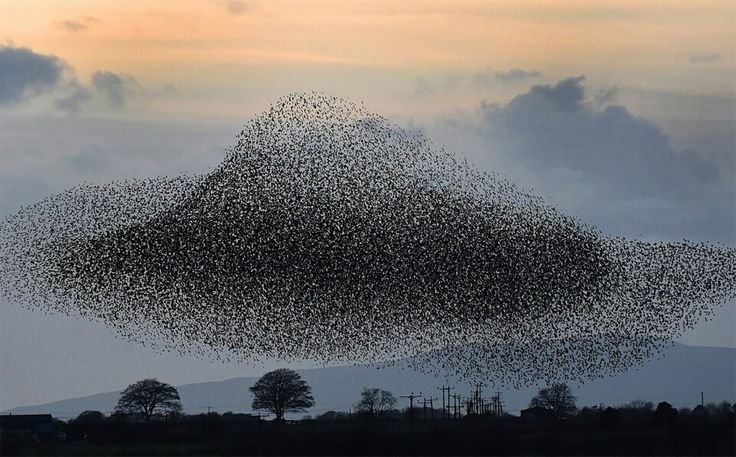
At the heart of swarm intelligence are several core principles: decentralization, self-organization, and emergent behavior. Decentralization allows individual agents to make decisions based on local information, fostering resilience. Self-organization leads to complex behaviors through simple interactions among agents. Finally, emergent behavior is the result of these interactions that create unexpected solutions to complex problems.
Many clever algorithms come from these ideas, like Ant Colony Optimization, Particle Swarm Optimization, and the Artificial Bee Colony model. These methods efficiently tackle optimization problems, enhancing various applications like network routing, robotics, and military.
Future Directions
While swarm intelligence systems offer advantages such as robustness, adaptability, and scalability, they face challenges, including coordination difficulties and computational costs. Understanding these limitations is crucial as researchers explore future applications of swarm intelligence in AI and autonomous systems. Ethical considerations must also be addressed, ensuring responsible deployment in real-world scenarios such as drone swarms and traffic systems.
Conclusion :
Swarm intelligence makes us remember something strong: greatness can be achieved through silent collaboration, not boisterous leadership. When lots of straightforward pieces—robots, bees, ideas—collaborate, they fix difficult challenges in ways that seem natural, durable, and effective.
There are problems, yes: things get untidy, unforeseeable, occasionally sluggish. But the point is, these systems learn. They bounce back from failures expand with size. They react when the world changes.
If we construct intelligently, swarm intelligence can assist us in having smarter cities, healthier worlds, smarter logistics, and more responsive technology. It’s not a neat concept—it’s a way to systems that are alive in action, not simply programmed.
FAQ’S
What is meant by swarm intelligence?
Swarm intelligence is the collective behavior of decentralized, self-organized systems, inspired by natural swarms like ants or birds. It enables simple agents to solve complex problems through local interactions without central control.
What is the difference between AI and swarm intelligence?
AI is a broad field focused on making machines think and act intelligently, like humans. Swarm intelligence is a type of AI where many simple agents work together to solve problems, inspired by nature.
How do humans use swarm intelligence?
Humans use swarm intelligence in things like crowd-sourced problem solving, traffic flow, and managing large networks. By working together and following simple rules, groups can find smart solutions without needing a single leader.
What is intelligent swarming?
Intelligent swarming is a collaborative support approach where the right people come together in real-time to solve a problem. Instead of passing issues between teams, experts swarm around it until it’s resolved.
What are real-world examples of swarm intelligence?
Real-world examples of swarm intelligence include ant colonies finding the shortest path to food, bird flocks coordinating flight patterns, and bees working together to build hives. In technology, it’s used in drone swarms, traffic routing, and optimization algorithms like Ant Colony Optimization.
IF YOU WANT TO KNOW ABOUT MACHINE LEARNING IN EMBEDDED SYSTEM